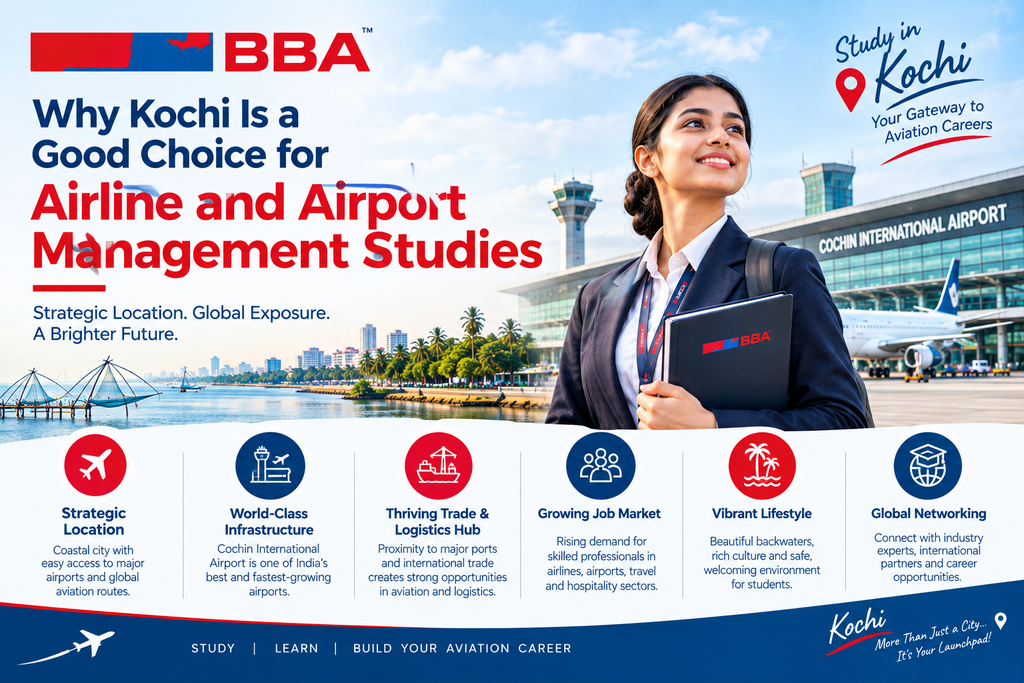
Kochi has a strong connection with travel, tourism, hospitality and aviation, making it a natural city for students considering an airline and airport management course. The city is also home to Cochin International Airport, so aviation is not an abstract concept here. Students can observe the ecosystem around an airport: passenger movement, airline counters, transport links, hotels, travel businesses and the many service providers that support a modern airport.
That does not mean that every aviation course in Kochi is equally suitable. The more useful question is what the student will actually learn and practise. A good programme should help learners understand airport operations, passenger services, airline processes, communication, reservations, ticketing and professional conduct. It should also explain how these functions connect instead of teaching isolated topics.
Kochi and the Aviation Ecosystem
Kochi connects aviation with tourism, hospitality, business travel and international mobility. This creates a useful context for students who want to understand more than the airport terminal alone. A passenger arriving in Kochi may interact with airlines, airport service providers, taxis, hotels, travel agencies and other businesses. Learning aviation in this environment can help students understand how different service industries depend on each other.
The Value of Being Near an Airport
Studying near an airport does not automatically mean students receive airport access or practical placement. What it does provide is geographic relevance. Students can learn about airport operations while living in a city where aviation is visible as part of everyday economic activity. They should still verify whether their chosen programme offers practical training, visits, simulations or industry interaction, rather than assuming that proximity itself provides experience.
What to Look for in a Kochi Course
A useful course should have a clear curriculum and should explain how aviation concepts are taught. Look for modules covering passenger handling, airport operations, reservations, ticketing, customer service and communication. If the programme advertises IATA, DGR or Amadeus-related learning, ask exactly what level of training is included and whether a separate certificate is issued.
Student Life and Professional Preparation
Aviation roles can be customer-facing, so students should use their course period to improve English communication, confidence and professional etiquette. Group activities, presentations and role plays can be valuable because they simulate real service situations. Computer skills also matter because modern travel and airport work relies heavily on digital systems and accurate data entry.
Career Options After Training
Graduates can explore roles in passenger services, airline ground support, reservations, ticketing, airport operations support and travel or hospitality businesses. Some roles may require additional employer-specific training. Students should treat the diploma as a foundation and continue building experience and specialised skills as they enter the industry.
A Practical Decision Checklist
Before joining, compare five areas: curriculum, practical exposure, credentials, career support and cost. Speak to the institute about the daily timetable and assessment method. Ask how students practise passenger handling or reservation concepts. Request clarity on placement support. Finally, check whether the course matches the kind of work you actually want to do. Kochi can be an excellent setting, but the quality of the programme remains the deciding factor.
Conclusion
Kochi offers a useful setting for aviation education, but students should avoid choosing a course solely because it is located near an airport. Compare the learning experience, practical exposure, credentials and career support. A thoughtful decision at the admission stage can make the training period more focused and productive.
Frequently Asked Questions
Q: Is an airline and airport management course in Kochi suitable after Plus Two?
A: Many diploma-level programmes are designed for students after Plus Two, but eligibility varies by institute. Always check the current admission criteria before applying.
Q: What subjects are usually included?
A: Common subjects include airport operations, passenger handling, airline reservations and ticketing, baggage and ground procedures, customer service, communication and aviation terminology. The exact syllabus varies.
Q: Can this course lead to airport jobs?
A: It can provide a foundation for entry-level airport, airline ground-service, passenger-service, reservations and related roles. Hiring requirements differ by employer, so the diploma should be viewed as preparation rather than a job guarantee.
Q: Is practical training important?
A: Yes. Practical exercises, role plays, simulations and system exposure can help students understand how aviation procedures work in real situations.
Q: What should I check before joining an institute?
A: Compare the syllabus, practical exposure, trainer profile, certification details, course duration, total fees, placement assistance and student support.
People Also Ask Questions
– Is Kochi good for aviation courses
– What should I look for in an aviation institute in Kochi
– What jobs can aviation students target?
Practical Tip
Students in Kochi can also think beyond the airport itself. The city’s hotels, travel companies, tourism businesses and transport services demonstrate how aviation connects with other customer-facing industries. That wider understanding can be useful when exploring first-job options.
Using Kochi as a Learning Environment
One advantage of studying aviation in a city with a visible travel ecosystem is that students can connect classroom topics to everyday observations. A lesson about passenger services becomes easier to understand when students notice how check-in counters, information desks, transport services, hotels and travel businesses interact. This broader view helps learners understand that aviation is both an operational industry and a service industry.
Kochi can also be useful for students who want to develop professional confidence. The city brings together local and international travellers, which creates many opportunities to practise clear communication and customer awareness in everyday situations. Students should treat communication as a career skill rather than a subject that ends with an examination.
At the same time, location should not become a substitute for course quality. An institute may be in Kochi but still provide limited practical exposure. Before admission, ask how often students practise operational scenarios, whether systems are demonstrated, whether industry experts participate and whether career guidance is structured. If the answers are vague, compare the programme with alternatives.
Students should also think about mobility. Aviation jobs can involve shift work and may be available in different cities or airports. Training in Kochi can be a starting point, but a graduate should be prepared to consider opportunities beyond the immediate neighbourhood if the right role requires relocation. This flexibility can be valuable at the beginning of a career.
